Monday, January 28, 2013

Full Moon Mindfulness Walk


Tonight was the first full moon of 2013.  Three months ago I started taking a walk on the first night of the full moon.  I've been calling it Full Moon Mindfulness Walk and, as the name implies, I walk for about an hour with the intention of being mindful of the present moment.  

Today it began snowing around two o'clock and continued snowing throughout the afternoon.  I took my walk at twilight.  The watery gray sky obscured the full moon and illuminated two inches of thick snow that covered the streets and sidewalks and buildings and trees and parked cars.  Huge flakes continued to fall.  My practice of mindfulness while walking felt heightened by the incredible beauty of the present moment.  The moment, so transitory in its nature, instantly struck me, and in an attempt to capture it, I took several pictures.  

Since it was snowing heavily all day and it was a Sunday evening most people had hunkered down in their homes.  I saw only a handful of people driving. Except for the falling snow, my little sliver of the world was still, and when you watch snow falling, in its steadfast slow descent and its almost hypnotic rhythm, you realize snow falling isn't still at all; it contains the most motion and movement in winter's stationary repose.  

The wetness of the thirty-two degrees felt welcoming compared to the crisp iciness of the below zero temperatures we've experienced for the last week.  Pine smoke from a chimney scented the air.  In the distance, I could hear the traffic of Interstate 35 North, not as loud or consistent as it usually is since most people heeded the travel advisory and stayed home.  As I followed the sidewalk down a hill, I could see the headlights of the cars traveling along this highway, few and far between but surprisingly steady. 

No one else had walked on the sidewalk I was walking on.  My footsteps would be the first.  This recognition evoked a memory, one I'd forgotten until I had looked back and saw my lone footsteps momentarily imprinted in the snow, soon to be covered, and soon I was lost in that memory.  

And back to the present moment.  

That's what you have to tell yourself a lot when you're practicing mindfulness: back to the present moment.  Whether you're walking or sitting or cooking or eating or driving or playing or creating, your mind wanders.  You remember the past; you dream about the future; you plan what you'll do when you're done being mindful; you analyze yourself; you ponder life; you imagine.  But since you're practicing  mindfulness, you gently remind yourself to return to the present moment and notice this moment, right here, right now with all of your five senses and with a still, open, and expansive mind.    

I continued walking.  I heard a jet fly over and then another one.  They use to drive me crazy.  Their sonic boom detracted from the perceived notion of peace I desired.  A good psychologist, an excellent book, and a mental makeover allowed me to acquire an acceptance of the airplanes that now lets me notice them without the attachment and judgment as much as I did before.  This is Zen.  As Shunryu Suzuki stated in Not Always So, “...just hear the big  noise or the small noise, and not be bothered by it.  It may seem impossible, especially for a beginner, because the moment you hear it, a reaction follows.  But, if you practice..., if you continually just accept things as it is, eventually you can do it..”  

I didn't see any people until the end of my walk.  A woman and a boy--a mother and son, I assume--bundled in black parkas and hats walked two black Labradors down the hill of the sidewalk as I walked up it.  The ebony movement in the white stillness was like black ink on white paper, live action calligraphy, a haiku awaiting creation.  

“Hello,” I said as I approached them.  “Beautiful evening.”
  
“Lovely,” the woman said.

Nothing more needed to be said between us.  Four words summed it up.  Often less is more.  

Perhaps seeing the boy made me think of snowballs because I wondered if I could make a snowball with this snow.  I bent down and scooped snow into my two gloved hands.  The fluffy snow fell through my open fingers like soft white flour.  I gathered another scoop and this time held it longer.  The warmth from my palms melted the flakes and I shaped the snow into a ball.  I held it, pressed it, turned it in my palms, aware of it, aware of the moment.  

And then I wanted to know what snow tasted like.  Or rather, I wanted to remember what snow tasted like, because I'm sure I've tasted snow before.  We have these precious images of people catching snowflakes on their tongues, and I'm sure I've done that, but I wanted more than that.  I wanted to really taste the snow.  So I bit into the snowball.  A big bite.  I let the snow melt in my mouth.  I noticed its coldness and texture, different than an icecube, which I have sucked on,  because a snowball is flakes of ice and an icecube is a cube of ice.  The density of ice makes the difference.  I took another mindful bite.  While the snowball melting in my mouth is cold water it tasted unlike water.  Snow tastes like snow, and until you've tried it, in large quantities, obtained as if eating apple, you don't really know what snow tastes like.   

Another memory emerged from the recesses of my mind, beckoned to play in the present by the visceral immediacy of eating the snowball.  I'm five years old.  I live with my family in the country about five miles from Holdingford.  It's winter.  I'm walking by myself along the perimeter of a snow covered shorn cornfield.  I'm eating a snowball.  So I have eaten a snowball before!  I have handfuls of peanuts still in their shells in my coat pockets.  I've been opening the shells, dropping the shells onto the snow covered ground, and eating the peanuts, and now, the snow from the snowball I'm eating quenches my thirst brought on by the dryness and saltiness of the peanuts.  I feel carefree and happy and alive and aware.  Walking across the flat prairie, the horizon rests at a vast distance, the world seems boundless, and the snow tastes iridescent.  

And back to the present moment.  


Thursday, January 24, 2013

Four Days of Solitude

The last two days of 2012 and the first two days of 2013 I gave myself the good gift of staying at home for four solid days.  I didn't leave the house once.   It was wonderful—peaceful, relaxing, creative, inspiring, and reflective.  I live alone so I'm use to and enjoy my alone time.  I teach 165 middle school students and am in a building with approximately 800  of these middle school students Monday through Friday, so evenings and weekends I often only want the quiet company of myself.  I savor the silence. I delight in the minimal decision making.  I practice mindfulness with the still life of the home I have created for myself. 

Mindfulness is certainly easier when you live alone and need to only pay attention to yourself.  Being able to practice mindfulness wholeheartedly without interruption except of my own devising is one of the reasons I like living alone.  I like people and I like spending time with people.  Some days, like these four days at home, I just prefer being with only myself more.   I have lived with people and I enjoyed it.  I would enjoy living with a roommate again or a boyfriend who becomes my partner again, but right now, as Henry David Thoreau states, I haven't “found the companion that [is] so compatible as solitude.”    

Each morning I woke up  at 5 a.m. without an alarm clock.  I felt refreshed and optimistic and at ease.  I sat in front of my fireplace,  drank two cups of coffee, and read five chapters from Walden, my favorite book ever since I first read it when I was in the tenth grade and my high school English teacher and drama coach, Mrs. N. (Peggy Noskowiak nee Killoren), gave it to me in 1986.  It's her copy from college,  complete with sentences she underlined and paragraphs she bracketed and asterisked.  I've read the book five times, more than any other book I've read.  I'm a Thoreauvian.

Before each morning dawned,  I went upstairs to my bedroom where I keep my meditation cushion and I sat mindfully for twenty five minutes.  I paid attention to my breathing, the steadfast sign that we are alive and the ready reminder of the present moment.  I listened to the clock ticking in the nearby master bathroom.  I silenced my mind when it began to wander, relatively quiet from the tranquility I had created and the early morning stillness of thought.  I watched the morning light slowly and softly fill the room.   

By choice, I had no company.  I talked to only one friend on the phone for about twenty minutes.  I texted only seven friends and family members on New Year's Eve and Day.  I stayed offline.  I watched TV once—CBS Sunday Morning.  I watched the last four episodes of Doctor Who: Season Seven, Part One on DVD, my favorite TV show ever since I watched my first episode in 1985. I've seen every episode and many of them multiple times.  I'm a Whovian. 

I drank tea.  I read. I wrote.  I prepared and ate meals with mindfulness.

On New Year's Eve day, around two o'clock, I opened a bottle of my favorite white wine, Kim Crawford's Sauvignon Blanc and kicked off my Zen party for one.  I listened to my current favorite CD, Ultra Lounge Bossa Novaville.  I made habernero enchiladas. I wrote in my journal and reflected upon and celebrated the past year.  I took my last sip of wine right before midnight, wished myself and the universe,happy new year, and went to bed, falling asleep quickly since it was two hours past by bedtime and I was up late partying zen style. 

On New Year's Day I spend most of the day reading and I also wrote in my journal again, this time looking forward into 2013—milestones I hope to create, things I hope to do, accomplishments I hope to achieve, things I hope to be thankful for, and what I hope to learn.  It's all about hope.  Hope for a happy new year and hope for a happy life.  Hope is the seed of a plan and a plan is the seed of action and action is the seed of reality.  Or as George Bernard Shaw wrote, “Imagination is the beginning of creation.  You imagine what you desire; you will what you imagine; and at last you create what you will.”  

We only take delight in what we have when we notice it; when we become mindful of the moments.  I attempted to do that as often as possible during my four day retreat.  Sequestering myself from the world——from other people and screens and online reality—time slowed down, and at the same time, time seemed fleeting.  Either way, those four days were a drop of water in the bucket of water called my life, and I'm glad I got the drop. 


Saturday, January 19, 2013

Follow Up to Telling My Students I'm Gay


Telling people you're gay is a difficult step to make. Not everyone wants to make it. Some people feel they don't need to make it. I did. I wanted to continue living my life authentically because I inherently and intrinsically believe that I and all gay, lesbian, bisexual, and transgendered people are no different than our heterosexual and onegendered counterparts. We are all people. We all deserve full acceptance.

When I came out to my students I told them, “You may not think you know any gay people, but there are kids in your class who are gay. They might not tell anyone, but they know. And when you go into high school or college or the workplace when you're an adult, you will know gay people.” It is possible, however, that these sixth graders already know someone who is gay. Maybe it's a middle school friend, maybe it's their older brother or sister in high school or college; maybe it's their uncle and his partner; maybe it's their own mom or dad, divorced and come out as lesbian or gay; maybe it's their two dads or two moms.

Because we are as far as we are in the gay movement, kids today are more aware of and accepting of gay people than the previous generation, and certainly more than my generation. Growing up, I knew of no other gay person in real life or on TV and movies. I thought I was the only boy who was attracted to boys. I didn't even have a name for this attraction until I was sixteen and a priest came out in the St. Cloud, Minnesota Catholic diocese. The mixture of news reporting and letters to the editor featured in the St. Cloud Daily Times informed me about this thing called gay. Until then, growing up in a rural town of seven hundred and forty nine people and attending a conservative Catholic church in the seventies and eighties, I heard, read, saw, and knew nothing about gay people. Unfortunately, the majority of responses was that of homophobic people sharing their views on homosexuality. Fortunately, for me and other gay people, the gay priest wrote often to the editor about sexuality and spirituality as compatible entities and about gay people deserving the same respect and rights as straight people. His wise words shaped my view of what it meant to be gay, and although I struggled with my own sexuality for another six years, I came out when I was a senior in college.
.
The Sunday before my first day back at school after telling my students I was gay—after our four day Thanksgiving break—I drove to school to prepare for the week. On my way there, NPR started a broadcast of Krista Tippet's show “On Being”. I listened to it in my car and continued listening to it online at my desk. The guest she interviewed was Brene Brown who spoke about her scientific research in the field of vulnerability and courage. She explained that “if courage is a value that we hold as important then vulnerability is the only way in and through. It starts by an openness to seeing ourselves and seeing how we protect ourselves from vulnerability.”

It was exactly why I was scared to come out to my middle school students. I didn't know how they would respond. I felt I was in a potentially homophobic environment from students' parents and students themselves. Over ten years I've heard the slurs the kids directed to each other in the classroom and halls: That's gay. You're gay. He's gay. And what gay meant in this context was weird, perverted, sick, gross, wrong. I always told the students not to use gay in the way they were because it was offensive, but I never told them that it was especially offensive to me because I'm gay. The known comfort of them not knowing was greater than the unknown discomfort of them knowing. Telling them forced me to confront that possibility. I've had many people comment to me online and in real life that what I did was courageous. I understand why it is courageous, and yet, it's unfortunate in our society that acknowledging who you are and who you love is regarded as an act of courage.

Brene Brown later stated in her interview that “most of us are brave and afraid at the same time.” It's true. You can't take any risk or make any significant change without being uncertain about the consequences. But in order to live the lives we wish to live we must set aside that uncertainly and step courageously into the unknown, trusting that with our best interests at heart we will succeed.

To some extent the students who clapped for me were as courageous as I was. To clap showed support, acceptance, and open-mindedness. To clap showed they believed that a gay man, their teacher, should be able to come out to his students without the fear of homophobic reactions. To clap showed they had decided to stand up, our school's anti-bullying campaign emblazoned on hundreds of red t-shirts in blue letters.

Maybe these particular children, in addition to the documentary, were the reason I could come out to them. They seem unlike any other group of students I've taught They're more aware of and respecting of cultural diversity. They're growing up with an African American president. They're growing up with a president and a political party that advocate desegregation of marriage, the last great vestige of discrimination in our country. They're growing up with gay teens on Glee and gay adults on Will & Grace and gay brothers, sisters, uncles, aunts, godfathers, godmothers, moms, and dads in real life.

There's a Zen saying: after the ecstasy, the laundry. It means that after you are enlightened (in my mind becoming aware of, accepting of , and appreciative of the present moment and the transitory and interconnected nature of life), you still do all the ordinary stuff of life like washing the dishes, folding the clothes, paying the bills, and spending your day at work. Only now you do them differently. You are awakened from a slumber of not being aware. You do them with acceptance and appreciation. You do them mindfully.

In a way it was like that for me after coming out to the my students. On Monday I went back to work. It was different: I was out. And yet, it wasn't different. I still had to teach. The studious students were still studious; the disruptive students were still disruptive. They didn't treat me differently. I didn't treat them differently. I was aware that many of them knew I'm gay and I was appreciative of that change. I wasn't hiding a part of myself anymore. I was challenging and changing students' perceptions of gay people. For many of them it really didn't matter. That's the reality of children today.

The only conversation I've had with students about my being gay took place this past week, about seven weeks after I told my advisory class. It was about forty five minutes after school. There weren't any other students in the common area as I walked from one teacher's classroom to mine except two girls staying after school for academic and behavior support. One of them, a spunky biracial girl with curly black hair pulled back in a long pony tail said, “Mr. Eich, can we ask you something?”

I immediately knew what they were going to ask me. “Sure,” I said.

“Some kids are saying something about you and laughing when they say it,” she said, “They're saying you're gay.”

My first emotional and cognitive reaction was that I didn't like that the kids were laughing about my being gay. This was one of the reasons I didn't want to tell them I was gay. This was the risk I took when I did tell them. But then, I thought, for some of them, knowing someone is gay, nonetheless one of their teachers, is an uncomfortable reality. Laughing could be meanness and small mindedness, the seeds of teasing or bulling, and laughing could be their way of dealing with their dissonance regarding affectional and sexual orientation. A second later, I composed myself and moved on. Yes, it hurt, but I'm stronger than the laughter of middle school children who are yet to be accepting of gay people.

I told the girl, “I am gay. I told my advisory class the day we watched the documentary about the boy who got bullied for being gay. Do you remember when we watched that? Right before Thanksgiving?”

“Yes,” the other girl said, a white girl with long blonde hair.

“I've been out for almost twenty years to my family and friends. All of the teachers here at the school know I'm gay. So I finally decided to come out to my students. If kids are asking, you can tell them. Just be appropriate and respectful and mature about it, okay?”

“Okay,” the biracial girl. “We don't care. We were just wondering.”

With that, we said our goodbyes and the two girls went back into the classroom.

Perhaps this conversation, like the entire experience of coming out to my students, is another sign that with this new generation of children, the days of don't ask, don't tell are over and acknowledgment and acceptance of gay people is truly the new normal. I hold hope that it is.

Thursday, January 10, 2013

Telling My Eight Year Old Godson I'm Gay

Three days after I came out to my students, my friends Jen and Jon and their eight year old son and my godson, Jonah, came to my house to celebrate my forty-third birthday.  While the four of us were eating, we started talking about my blog and the thousands of people who had read it because of the link on Out.  Jonah asked his dad, “What was his blog about?” 

Jon said, “James told his students something and wrote about it.” 

Jonah asked, “What did you tell them, James?”

Jen and I looked at each other and, like the moment where I knew with my students that now was the time to tell them, now was my opportunity to tell Jonah I'm gay.  You might wonder why he didn't know.  The reason is there was never a good opportunity to tell him.  It never came up in conversation.  I haven't had a boyfriend that would make it obvious to him.  I could have deliberately told him, but that felt contrived. 

Unlike my middle school students, I never worried about telling Jonah.  Jen and Jon know I'm gay; many of their friends are gay.  They would have been and are fine with Jonah knowing I or anyone else is gay.  I think it's like this for a lot of gay people.  Finding a natural  moment to tell someone you're gay if you've not made a comment that reveals it doesn't always  present itself.  The alternative is saying that no matter what on this day and at this time and in this situation you will tell someone you're gay. 

I smiled and said to Jonah, “I told my students I'm gay.”

“Do you know what gay means, honey?” Jon asked.

“It means a boy wants to marry a boy and a girl wants to marry a girl,” Jonah said. 

So simple. So beautiful.  Out of the mouth of an eight year old boy.

Jonah said, “I voted no.” 

“We all voted no,” Jon said, “Mommy and daddy, and James, and if you could vote, you would have voted no too.”

“They weren't going to let a boy marry a boy if he wanted to or a girl marry a girl is she wanted to,” Jonah said. 

What Jonah referred to was the Marriage Amendment to the Minnesota Constitution that would have defined marriage between a man and a woman.  Minnesotans United for All Families, the organization against the amendment created a Vote No campaign that featured bright orange and blue yard signs.  Many people in Minneapolis where Jen, Jon, and Jonah live placed them in their front lawns.  Jonah saw the signs and Jen and Jon explained the signs.  They also explained gay in a way that he would understand in conjunction with these signs: gay means a man loves a man and wants to marry that man or a woman loves a woman and wants to marry that woman.  Not letting them do this is wrong.  This is what two gay accepting parents can teach their child.  This is the future generation if we, straight and gay people alike, continue to teach children that gay people deserve acceptance and awareness and respect and rights. 

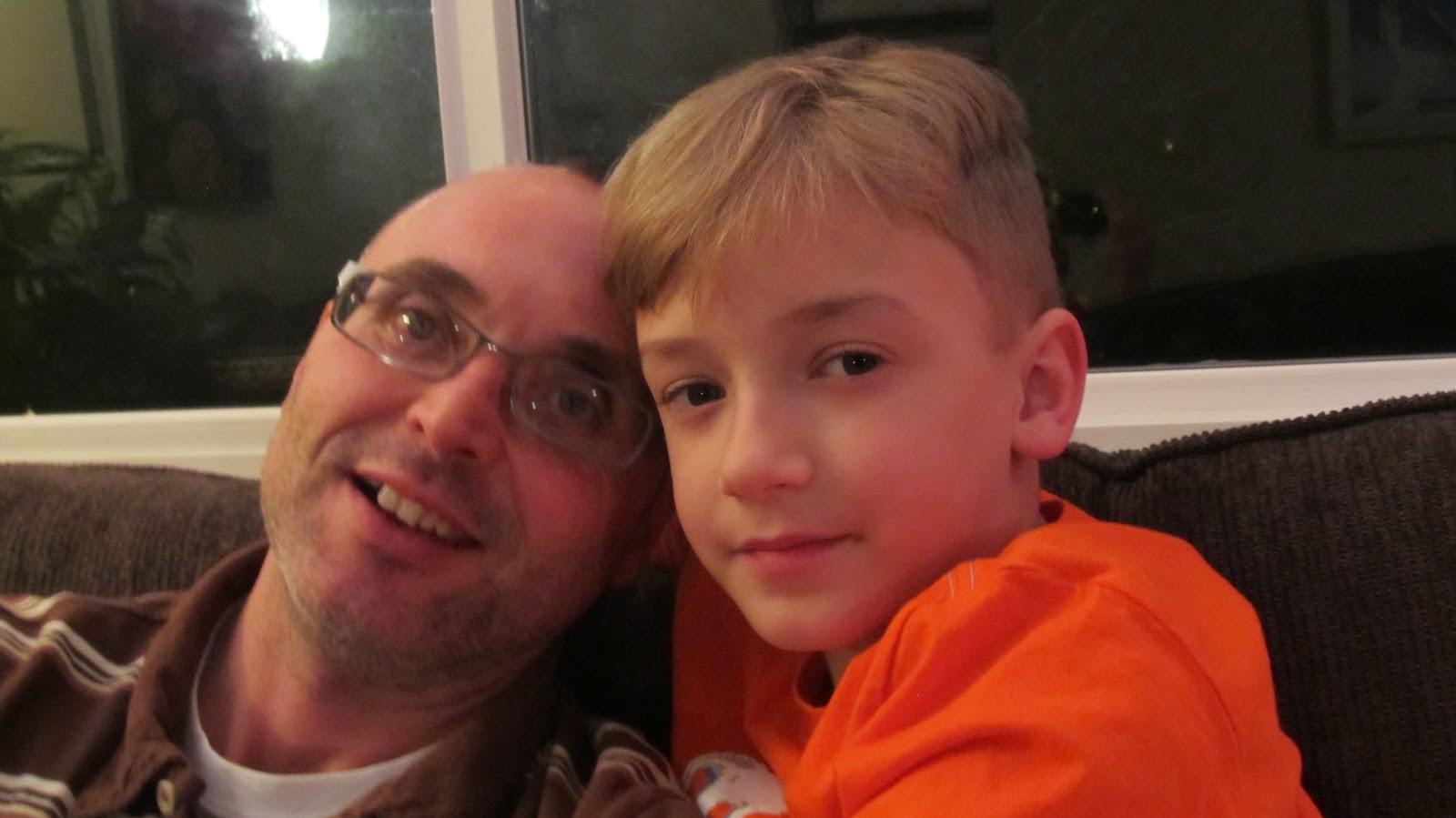
We finished our meal and went into the living room.  Jonah said, “Mom, can you take a picture of James and me on the couch?”

I'm not sure why he wanted a picture of the two of us right at that moment, but I like to think that he wanted to capture the moment and create a memory:  when James told me he was gay.  Or at least that's how I look at the picture now:  when I told Jonah I'm gay.  He looks content. I look happy.  That’s the way it should be when you tell a child you’re gay. 


Thursday, December 27, 2012

Mindfully Eating a Lemon


Since our middle school starts at 7:25 and the sixth graders I teach don't eat lunch until noon, I let them eat a snack during their third hour class.  One mid-morning, while standing in line along the wall outside my classroom door waiting for class to start, I saw a boy holding an unpeeled lemon.  I was a bit confused as to why he had a lemon so I asked him. 
 
Giving me a quizzical look, he sarcastically said, “Um, it's my snack.”
 
“The lemon?  The lemon is your snack?” I asked.  “What are you going to do with it?”
 
“I'm going to eat it,” he said. 
 
“You're going to eat it?  The lemon?  How?” I asked.
 
“I'm going to peel it and eat it.”  Duh. 
 
He rolled it in his hand and started to peel it with his fingers, like you'd peel an orange.  He held the peelings in the cupped palm of his left hand and then tossed them into a nearby garbage can.  When he came back, he separated a wedge from the whole lemon and bit into the wedge and ate it. 
 
“I've never seen someone eat a lemon like that before,” I said to him.
 
“Okay,” he said, still incredulous that I was asking him about his lemon.  “Well, how are you supposed to eat it?”
“I slice it in thin strips and put it in water or squeeze it on food.”
 
Then a girl standing next to the boy said, “You have to try eating it whole then, Mr. Eich. It's amazing.”
 
Another girl chimed in.  “It's so sour in your mouth.  It's delicious.”
 
I noticed that several kids standing in line were listening to this conversation.  “Do you all eat lemons like this?” I asked.
 
Several of them said yes.
 
“Okay,”  I said,  “I'll try it.”
 
I realized that these kids have grown up sucking on sour candy and that a lemon wedge popped into their mouth, its sour juice squirting on their tongue, tastes familiar, and yet, better than the candy they love because it's the real thing from which they derive their enjoyment of sour candies.  I also realized that this is a generational difference.  I know no adult who peels and eats a lemon like he or she would an orange.  I'm sure they're out there, but I haven't met or heard of any of them. 
 
Several days later, I bought a lemon with the intent of eating it like I would an orange: peeling it with my fingers rather than slicing it with a sharp knife into thin strips, separating the wedges, and then placing half in my mouth, and biting into it, and if possible, eating the entire lemon like this.  I like lemons but I do find them sour.  When I set out to peel the lemon, however, I couldn't break through the thick yellow skin with my finger or thumb.  I squeezed the lemon in my hand hoping to soften its skin.  No luck. I set it aside and waited for several days. 
 
I've been teaching my students poetry, descriptive writing, and the personal narrative for  the past three months and what I repeatedly tell them is to pay attention to the five senses and to incorporate these details into their writing.  Writing requires concentration, I tell them.  What I am essentially teaching them is mindfulness.  Writing requires mindfulness.  Eating requires mindfulness.  Or rather, it can.  We don't always have to write or eat with such mindfulness, but sometimes, and I would suggest often, eating or writing or walking or making food with mindfulness helps us to appreciate what we are experiencing more.  That's why I want to mindfully eat the lemon: to experience the taste and to be more aware that I am experiencing it. 
 
My opportunity to eat the lemon arrives on the morning of Christmas Eve.  I'm alone with no distractions.  I have nothing I need to do except mindfully eat the lemon. I set it in a large silver stainless steel bowl.  I grab a folded black cloth napkin.  I make a cup of green tea. I take all three items to my writing room/guest bedroom and sit on my bed.  Winter sunlight pours through the large rectangular window.  The sky is blue.  A thick layer of snow covers the roof tops of the neighboring houses.   I hear a jet passing overhead, first a sonic roar booming close and then fading into the distance until the sky is silent again. 
 
I hold the lemon in the palm of my hand.  Like goosebumps, miniscule dots cover its bright yellow skin.  I smell it.  It smells of lemon skin rather than lemon.  I squeeze it.  The lemon is solid.  I massage the lemon to loosen it up.  I attempt puncturing its skin with my thumb but am unable.  Wanting to eat it and not wait until another time, I bite  into the lemon.  My bottom teeth easily pierce the skin.  I taste the peel on my tongue. 
I begin to peel it.  I take my time.  I end up with five peelings, one of them almost half the lemon.  Because the skin is still hard there is a thick skin surrounding the lemon.  It's as if there were two skins, the outer skin and the inner skin, both of them attached to each other.  I start to pull off the thin skin in tiny strips.  Sometimes I can see the membrane on the skin.  It's a creamy white color, unlike the fruit itself which is more of a translucent amber. 
 
When the lemon is peeled, I pause for a moment and look at the whole lemon sitting there in the palm of my hand like a large egg in a nest.  The sticker attached to the skin stated the lemon was from California.  We often take it for granted that we can get citrus fruit at the beginning of winter.  We're used to going into a store and seeing all the fruits and vegetables—all the food we want from any location around the world—at all times of the year.  And yet, we should appreciate this fact.  It is nothing short of miraculous.  Modern technology allows us here in our first world abundance to eat fresh food from around the world. 
 
In Zen, many people teach the concept of interconnectedness.  The lemon is a good example.  Someone planted the seeds that grew into lemon trees.  The sun and rain and soil nourished the plant which allowed it to grow.  Someone probably sprayed pesticides on the trees which made them resistant to bugs and gave them a longer shelf life.  Someone picked the lemons; someone inspected them; someone crated them; someone loaded them on semis; someone drove that semi from California to Minnesota; someone unpacked the lemons and placed them in the bin at the store; someone rang up my purchase and took my money and placed the lemon in the grocery bag.  The interconnectedness is infinite.  Consider, for example, the people who built the lemon and semi factories, the lumber, steel, and concrete for these factories, the people who refined the oil for the gasoline that transported everything, the people who built the roads and the roads themselves traveled for all of these natural resources.  The lemon became mine because of the interconnectedness of many people and many natural elements and events. 
Finished with my moment of reflection, I start part three: taking apart the wedges.  As I do, the juice from the lemon gathers on my fingers and releases its aromatic sourness.  There's a slurping, sucking sound each time I take a wedge apart.
 
When I'm done taking apart the wedges, it's time for the finale: eating the lemon.  I bite into a wedge. It's sourness squirts into mouth.  It's a startling and exhilarating sensation.  The tartness makes me smile.  I put the second half of the wedge in my mouth.  A similar sensation.  I put the next wedge, whole, into my mouth.  Biting into it releases a gush, a geyser of citrus and lemony sourness. 
 
I slowly continue eating the wedges, and as I do, I realize their sourness isn't as sharp and as particular as when I first started.  I've gotten used to the sourness.  I've appreciated the sourness. 
 
It's a good reminder that life is often like this: it takes us a while to get used to that which is sour but even the sourness can have a good taste.  When we slow down we can become mindful.  When we become mindful we can appreciate life more—even the sour parts. 
 
My students were right:  eating a lemon is an amazing experience.

Wednesday, November 21, 2012

Coming Out to My Students


I did something momentous today. Something I’ve wanted to do since I first started teaching middle school ten years ago.  I told a group of my students (20 sixth graders in my advisory group) that I am gay.  I was ready and the time was right.  Our entire middle school (6th through 8th grade) had watched a documentary called “Bully” about Jamie Nabozny, a gay man who was bullied for being gay, starting in the sixth grade and continuing throughout high school.

After the movie, all teachers at our school led a discussion about the documentary and bullying.  At one point I asked, “What was this movie really about?”

A boy said, “About a gay boy who was bullied and beaten and how we need to accept gay people.” 

“Right,” I said.  “You may not think you know any gay people but there are kids in your class who are gay. They might not have told anyone, but they know. And when you go into the high school, or college, or the workplace when you’re an adult, you will know gay people.  They are everywhere. There are millions and millions of gay people in the world.” 

Then I realized I was talking about these “gay people” as if I wasn’t one of them, and I decided, in a split second, that the time was now, and I was going to tell them.  Now is the time, I thought. Here is your opportunity. 

“You may not know this,” I said, “but I’m gay.”

 Pure silence.  All eyes on me. 

“I was teased in middle school and high school. Not because I was gay, but because I was different. Because I grew up in a small town and I didn’t hunt or fish or play football, and instead was smart and liked theater and speech.” (I should have added and had impeccable taste in shoes.) I continued: “Kids pushed me and shoved me and called me faggot and queer and gay, and for that reason middle school and high school was really awful.  But when I got to college I realized there were other gay people and I wasn’t alone and I came out. I told my family and friends and they all accept it. All of the teachers here at school know I’m gay.  I’ve been out as a gay for twenty years.  I’ve never told my students because I was scared, scared of what your parents might think, scared of what you might think.  But today, watching the movie about Jamie, I realized that if an eleven year old boy in a small town in Wisconsin can come out, then I as a forty three year old man can come out to my students at the school where I teach.” 

I stopped. I had said what I wanted to say. I had said what I never thought I would say. I had said what I had practiced in my head so many times hoping for the right time and the courage.

 And then a girl clapped her hands.  And then a boy.  And then the whole class. They were all clapping for me. Clapping because I had been courageous with them and told them I was gay.  I felt relieved and scared and exhilarated and proud all at the same time. 

A girl in the back raised her hand.  “So are we the first class you’ve ever told?”

“Yes,” I said. 

“That’s really cool,” she said. 

A boy raised his hand. “Are you going to tell your other classes?” 

I smiled and laughed.  “I’m sure they will all find out.  You’re all going to put it on Facebook, right?” Several laughed.  “I’m sure most kids will know by Monday,” I said.

It’s true.  With news like this and texting and Facebook, they will share the information.

Before I left for the day and the four day Thanksgiving break, I also told several teachers, my principal, assistant principal, and discipline coordinator.  From all of them I got unwavering support. They were happy for me, they were proud of me, and they understood the difficulty of hiding my gay self that I have been doing for ten years with students.  Each of them said the same thing to me, the theme of the anti-bullying campaign at our school: We will stand up for you.  And I know they will.  Any backlash from narrow minded and prejudiced parents who think a gay man who is a middle school teacher shouldn’t tell his students that he is gay will be dealt with in a  twenty-first century way: acceptance and celebration of gay men and women who deserve all the respect and rights of their heterosexual counterparts. 

On this Thanksgiving Eve, I certainly am thankful that I came out to my students. I am thankful that I work in a school environment that has created a culture and community where I can come out.  I am thankful that I know I work with people who will support me and stand up for me.  I am thankful that I am proud enough and courageous enough to come out in this capacity.  It’s been a long road to get here.  But life is a long road.  A long wonderful road that I am thankful I am walking on in my own way. 

Saturday, November 17, 2012

Just Sitting for Ten Minutes


It's Sunday morning. I'm drinking coffee, sitting by the lit fireplace, reading a book, and enjoying the quietude. I hear the steady humming of the refrigerator and my own breathing, and now, a jet plane passing over in the distance.

I woke up this morning, showered, and meditated for ten minutes. It felt good to meditate right away. A good way to start my Sunday, a good way to stop and sit and not do anything. So often I've got a mental list of things I want or need to do: eat, clean, read a book, get ready for work. I'm not a crazy busy overbooking multitasking person but I like to use my time efficiently and effectively-there are only so minutes in the day and I want to use them wisely-and so I plan what I'm going to do with the minutes.

Meditating-just sitting as I like to call it-is “doing” something, but it represents the bare necessity and the simple essential. Often for myself, and others, just sitting there and “doing nothing” is difficult. We get mentally and physically restless. We have the mental list of things we could or should or would like to do instead of just sitting. We have the mental list of things we could or should or would like to do after we are done sitting. We have the machinations of our minds: the wondering and worrying, the remembering and envisioning. If you're like me, you think a lot. If you're like me, you think you should always be doing something, whatever that is. Just sitting there seems idle and counterproductive to the creative and successful person.

But I did just sit there. I stopped. I just sat. For ten minutes. It may not seem like a long time. It's certainly not the two periods of thirty five minutes every Tuesday, Thursday, and Sunday or the all day meditation retreat I used to sit ten years ago, but ten minutes is where I'm at right now and wherever I am is where I am.  I accept that.

Ezra Bayda states in his book Saying Yes to Life (Even the Difficult Parts) that “equanimity is being present with whatever is happening without believing our judgments about it.” What this means is that when I'm just sitting I just sit. I don't judge it. I don't say it's good or bad. I don't tell myself I'm distracted and unfocused, or the opposite, I'm concentrating and clear minded. Similarly, when I'm done just sitting, I don't judge the sitting, and I don't judge whatever I'm doing. I just do it: just drinking coffee, just sitting by the lit fire, just reading, and just enjoying the quietude.